DUBAI PROPERTY · PRACTICAL GUIDES
Ready Property vs Off-Plan Dubai: How to Choose Your Route

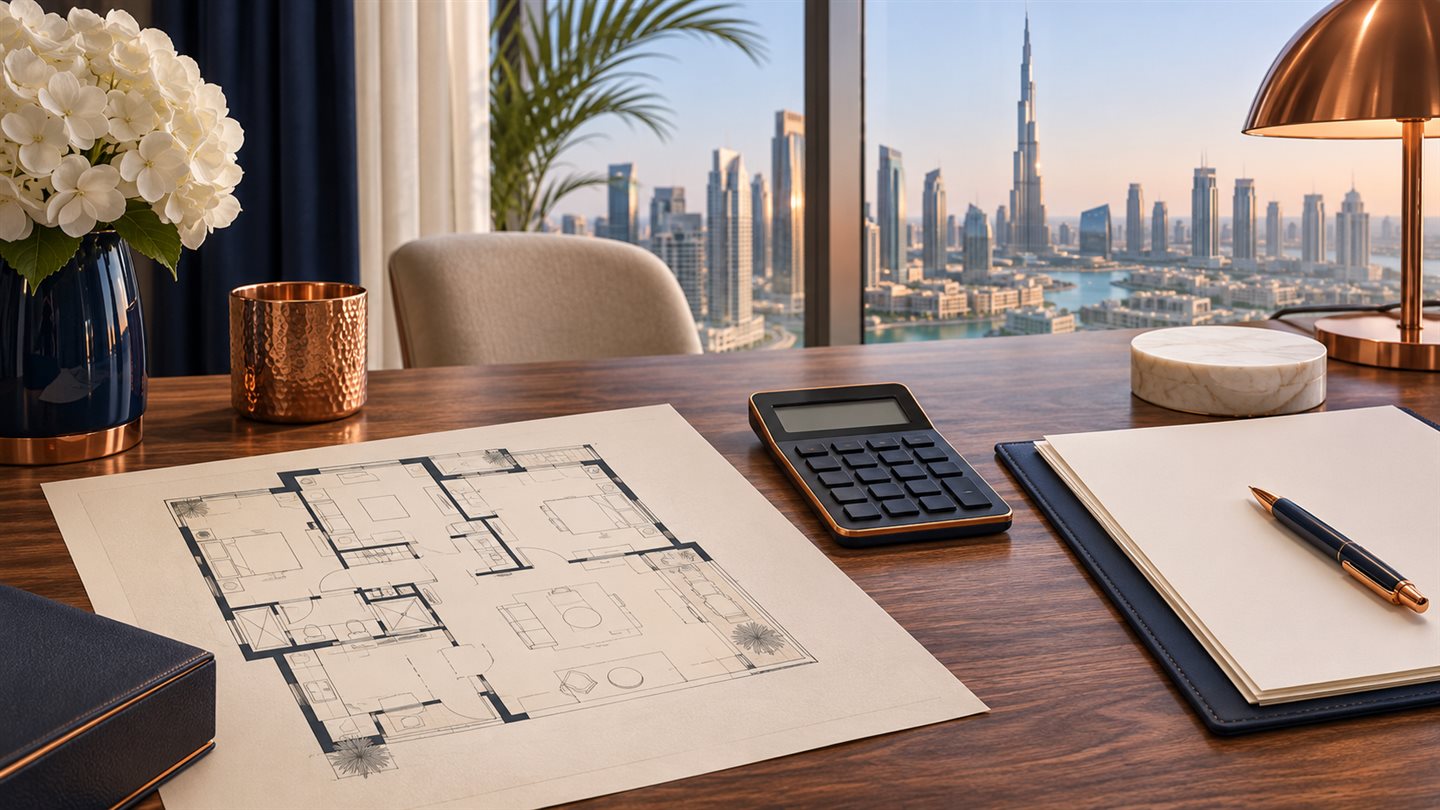
Illustrative image created for this guide.
THE QUICK ANSWER
Ready property lets you assess an existing home and its current setting; off-plan property involves buying before completion under a development contract. Neither route is automatically cheaper or more profitable. Choose by your required occupation date, available cash, ability to absorb delays, condition checks and the rights in the actual agreement.
Key takeaways
- Compare a specific completed property with a specific off-plan unit, using the same location and ownership objective.
- A completed building does not establish vacant possession, legal clearance or freedom from defects.
- A staged payment plan changes when money is due; it does not remove the obligation to fund the full purchase.
- Model rental income after realistic costs, vacancy and financing rather than relying on gross yield.
- Check official property or project records and obtain independent advice before signing.
Start with the decision you actually need to make
Comparing ready property vs off-plan Dubai becomes easier when you stop asking which category is universally best. The useful question is which specific property route can meet your needs without requiring assumptions you cannot afford to get wrong. A family moving before a school term has a different problem from an investor who can wait several years. Someone seeking regular rent has a different problem from someone prepared to fund construction exposure.
Write down three things before looking at advertisements: the latest acceptable use date, the maximum cash you can commit without exhausting your reserve, and the purpose of ownership. Rank those constraints. If immediate occupation is essential, a delivery estimate cannot replace an available home. If you cannot fund a large final instalment, a small booking payment does not make the property affordable.
The Dubai property alternatives overview introduces ready homes, resale and development participation. Here, the comparison is specifically between purchasing a completed property and purchasing a unit before completion. Project participation is discussed separately because its legal and economic structure can differ from ownership of a particular apartment.
Use a one-page decision brief that you can give every agent. Specify bedrooms, practical location, parking needs, annual holding budget and financing status. Ask each agent to identify which requirements are supported by documents and which remain estimates. That simple distinction prevents a persuasive presentation from changing the question halfway through your search.
What do ready, resale and off-plan mean?
A ready property is an existing completed home. Resale describes a sale by an existing owner rather than the original developer. The terms overlap, but they are not interchangeable: a developer may sell completed stock, while an owner may sell a contractual interest in an unfinished unit. Always ask about physical completion, registration and the form of the transaction separately.
Off-plan usually means committing to purchase before the property is completed. Your assessment therefore relies more heavily on approved plans, specifications, project progress, payment obligations and the contract. A show apartment helps explain finishes and proportions, but it is not the particular unit you will receive. A digital view illustrates a proposed outlook; it does not establish what neighbouring plots will contain.
| Question | Completed home | Off-plan unit |
|---|---|---|
| What can you inspect? | The actual unit, common areas and neighbourhood | Plans, specifications, show units and documented progress |
| When might you use it? | After transfer and any possession or tenancy requirements | After completion, handover and required arrangements |
| What drives uncertainty? | Condition, title, occupancy, costs and future resale demand | Delivery, specifications, funding, contract rights and future demand |
| What must the budget cover? | Purchase, transaction costs, works and holding costs | All instalments, transaction costs, handover funding and later holding costs |
Neither label establishes investment quality. A well-priced existing home can be a poor choice if it cannot serve your purpose. An attractive new project can be unsuitable if its payment schedule leaves you dependent on an uncertain resale.
Compare usable dates, not just completion labels
For a completed property, distinguish completion from possession. A unit may be occupied by a tenant, undergoing repairs, awaiting seller clearance or subject to a transaction that depends on a mortgage settlement. Before treating it as available, ask what must happen before you can receive keys and use it. Record those dependencies in the purchase timetable rather than relying on an agent’s informal estimate.
For an off-plan unit, map the sequence from projected construction completion to inspection, correction of defects, final payment, handover, utilities and occupation. The exact process depends on the project and agreement. Ask which dates are contractual, which are estimates, what extension provisions exist and what remedies require formal action. A date printed on a brochure should not be treated as a guaranteed moving day.
Then calculate the cost of being wrong. If a hypothetical buyer needs temporary accommodation costing AED 8,000 monthly, an additional six months would require AED 48,000 before considering moving or storage. This example is arithmetic, not an estimate of Dubai rent or a forecast of delay. Its purpose is to make the timing risk visible in the same spreadsheet as the purchase price.
Use three dates: an expected date, a cautious date and your personal deadline. If the cautious date would cause serious financial or family disruption, the property needs a stronger contingency plan or should leave your shortlist. A home can be financially attractive and still be the wrong answer to a fixed deadline.
What can inspection tell you about a ready home?
Inspect the actual unit in daylight and, where practical, at a different time of day. Look at layout, natural light, noise, ventilation, storage, parking access and the route between the lift and the front door. Test the ordinary experience of living there. A beautiful lobby does not tell you whether bedrooms face a busy loading area or whether a parking bay is difficult to use.
Separate cosmetic condition from systems and structure. Fresh paint can conceal a maintenance history, while an untidy but sound apartment may be relatively straightforward to improve. An independent qualified inspector can help identify issues outside a normal buyer’s expertise. Ask for a written report defining its scope and limitations, and obtain estimates for material work before negotiating the final price.
Common areas matter because you will share the cost and experience of the building. Observe lifts, access control, drainage, refuse facilities, maintenance response and the condition of amenities. Ask management about planned works and recurring problems. Treat an unanswered question as an information gap, not proof that there is no problem. Keep dated photographs and written responses in your property file.
Do not confuse inspection with legal verification. An inspection cannot establish seller authority, validate a title deed or confirm that promised possession can be delivered. The resale buying checklist covers those transaction checks. A completed asset provides more physical evidence, but you still need the evidence that addresses each separate risk.
How should you assess an unfinished development?
Begin with the project identity rather than the marketing name alone. Obtain the developer’s legal name, project number, precise unit reference and the documents that define what you are buying. Check that the name and identifiers match across the reservation form, payment instructions and purchase agreement. Ask for an explanation of any discrepancy before transferring money.
DLD’s Project Status Enquiry provides a route to project information and completion details. The official brokerage practice guide also directs brokers marketing off-plan projects to verify registration and the associated escrow account. Use these official checks alongside the actual contract; registration is an important check, but it does not forecast your investment outcome.
Review specifications in detail. Identify the unit’s permitted use, area basis, floor, orientation, parking entitlement and included fittings. Ask how material changes, area differences and substitutions are handled. If the commercial appeal depends on a promised view, amenity or surrounding infrastructure, find out where that promise is documented and what happens if the final result differs.
For payments, independently confirm the beneficiary and approved project payment details through reliable channels. Do not accept a changed bank account solely because a message looks familiar. Keep receipts and reconcile the payment ledger. Ask a lawyer to explain missed-payment provisions, cancellation conditions, dispute processes and exit restrictions in plain language before you commit. Good questions at this stage cost less than trying to reconstruct your rights after a disagreement.
Compare the full cost of both routes
Prepare a total acquisition budget for each candidate. Include the price, registration charges, agreed brokerage, financing costs where relevant, professional advice, inspection, immediate works and any administration charges applicable to the transaction. Separate confirmed written amounts from placeholders. A comparison based on different inclusions is unreliable even when every individual number is accurate.
DLD’s Property Sale Registration service publishes transaction requirements and fees for completed property sales. Confirm the applicable current charges and their contractual allocation for your transaction rather than assuming a marketing headline covers everything. Our Dubai property buying costs guide explains how to organise the broader budget.
For off-plan, show every instalment by date and identify the source of funds. Include any substantial handover balance. If you expect to use a mortgage later, record that as an assumption until a lender has assessed the actual circumstances. Approval conditions, valuation and your personal eligibility may change; a future loan should not be treated as cash already available.
Keep a reserve outside the purchase budget. A reserve must remain accessible after expected payments, not exist only as a future salary or hoped-for resale profit. Set it with reference to your own household commitments, potential property costs and uncertainty. If either route consumes every available dirham, the affordability problem deserves attention before you debate which building has better amenities.
A worked comparison of cash timing
Consider two invented purchase options, both advertised at AED 1,200,000. Option A is a completed apartment requiring the price at transfer, funded by a combination of buyer cash and any approved mortgage. Option B requires 20% initially, 40% across construction and 40% at handover. These are illustrative payment terms, not offers or typical market terms.
For Option B, the payments are AED 240,000 initially, AED 480,000 across construction and AED 480,000 at handover. The smaller first payment does not reduce the AED 1,200,000 price. It changes the timing and introduces a future funding requirement. Add transaction costs and any handover-related costs separately, using the actual project’s documents when applying the model.
For Option A, compare the actual mortgage offer, buyer contribution and ongoing instalments, or the opportunity cost if buying entirely with cash. For Option B, compare savings capacity against every instalment deadline. Do not assume the same amount of available borrowing, the same interest cost or the same period without income across both routes.
A useful spreadsheet has columns for date, payment category, confirmed amount, estimated amount, funding source and remaining liquid reserve. Test a delayed bonus, a lower valuation, a longer vacancy and a later use date independently. The objective is to discover which dependency could prevent completion. A payment plan is most helpful when it matches reliable cash generation; it is dangerous when it merely postpones a gap you have not solved.
Can ready property produce income sooner?
A completed home can potentially be leased after the purchase and relevant arrangements, but income is not automatic. The unit must be available, suitable for letting and able to attract a tenant on workable terms. Existing tenancy can provide an established contractual position, although it also limits immediate owner occupation and requires scrutiny of rent, deposits, maintenance and payment status.
Compare income using a net operating model rather than a large annual rent divided by the advertised price. Deduct expected service charges, maintenance, management and vacancy. Keep financing costs distinct so you can see the property’s operating performance before considering the effect of borrowing. Our net rental yield guide develops the calculation and its limitations.
For an unfinished unit, model the period before rent can begin. During that period you may be paying instalments while also funding your own accommodation. Avoid crediting hypothetical appreciation as if it were cash available to pay bills. Price growth becomes usable money only through a transaction or borrowing arrangement that actually completes, with its own costs and conditions.
Compare like with like. A new waterfront apartment and an older inland home may serve different tenant groups, have different expenses and attract different resale buyers. If your conclusion changes when you adjust one optimistic rental assumption, investigate the evidence behind that assumption. A robust choice should make sense with cautious inputs, not require every forecast to be favourable.
Inspect the present neighbourhood and question future plans
A completed neighbourhood lets you observe current transport routes, shops, schools, pedestrian access and traffic patterns. Visit at the hours relevant to your own routine. A weekend viewing cannot establish a weekday commute. If a property is intended for tenants, examine the practical reasons someone would choose to live there and the alternatives they could rent nearby.
For an emerging community, separate operating amenities from planned ones. Ask who is responsible for delivery, whether public approvals exist and what timetable is documented. Do not value a property as though every proposed surrounding development already exists. Some plans may improve an area, while other construction can change views, noise levels and travel patterns.
Make location testing specific. Time the journey from the parking bay to the main road; check visitor parking and delivery arrangements; walk the route to daily necessities; and consider accessibility for children, older relatives or people with mobility needs. These observations are personal research, not a ranking of Dubai districts. They help you decide what matters to your own household or tenant profile.
Future supply also matters. Ask how many similar units could compete for tenants or resale buyers when you expect to use or sell the property. You may not be able to estimate supply precisely, but you can identify whether the investment depends on a scarcity claim. Treat broad citywide growth narratives as context, then return to evidence about the actual building, unit and competing stock.
Compare risks and exits before committing
Ready property carries condition, occupancy, title, financing and market risks. Off-plan adds greater reliance on future delivery and the terms governing unfinished property. Neither category removes the chance of losing money. A stronger comparison asks what could go wrong, how you would identify it and what resources or rights you would have in response.
Write an exit plan for a normal sale and for a sale under pressure. Estimate selling costs, mortgage settlement where relevant, potential refurbishment and the time needed to find a buyer. For an unfinished unit, read the actual assignment or resale conditions and identify any approvals, payments or restrictions. Do not assume you can sell whenever you choose simply because resale is mentioned in marketing.
Distinguish liquidity from price. A property may have an attractive estimated value but still take time to sell. A discount may produce interest without producing a completed transaction by your deadline. If you need your capital back on a fixed date, the uncertainty of a property exit should be reflected in your decision and your reserve.
Development participation requires a separate review. If you are considering a pooled arrangement instead of an apartment purchase, read the development participation guide. Confirm what interest you receive, who controls decisions, how distributions work and how you leave. An ownership narrative should never substitute for identifying the legal asset or contractual right being purchased.
Use an evidence scorecard for your shortlist
Create one consistent scorecard and use it for both routes. List five criteria: suitability for your goal, funding resilience, property or project evidence, ongoing cost visibility and exit flexibility. Give each criterion a personal importance weighting before reviewing the candidates. Otherwise, you may unconsciously change the scoring system to favour the property you already prefer.
For every score, add its evidence. “Good location” could refer to an observed commute and suitable amenities; “manageable costs” should refer to written charges and a cautious maintenance allowance; “suitable timing” should refer to a documented possession position or a realistic contingency plan. A high score without supporting information is an unanswered question dressed up as certainty.
Use a separate red-flag list that cannot be averaged away. Unclear seller authority, mismatched payment instructions, unaffordable future payments or an essential promise absent from the contract should pause the process regardless of the overall score. Seek professional clarification rather than treating a low price as compensation for a risk you cannot evaluate.
For foreign buyers, the UAE Government’s ownership guidance explains that Dubai foreign ownership is permitted in designated areas. Verify the rights applicable to the specific property. Eligibility, ownership form and financing are separate questions; a positive answer to one does not establish the others.
How three different buyers might use the comparison
A household with a fixed moving date
This buyer prioritises actual availability, occupation conditions and a workable commute. An existing vacant home may provide clearer evidence, but inspections, transfer dependencies and preparation works still matter. The comparison should include the cost of overlap between rent and ownership. A future delivery promise only becomes viable if the household can comfortably accommodate a later move.
An investor seeking operating income
This buyer examines achievable rent, ongoing costs, tenant demand and management effort. An occupied property requires review of the actual tenancy rather than an assumed market rent. A vacant unit requires a leasing plan and vacancy allowance. Off-plan may fit a different investment objective, but it should not be described as an immediate-income substitute while construction remains incomplete.
A buyer who values new specifications and can wait
This buyer may prefer the proposed layout, amenities or design of a new development. They still need to assess project evidence, specification changes, payment deadlines and the final funding requirement. Waiting capacity is valuable only if it is financial as well as personal. A buyer who can delay occupation but cannot absorb a delayed exit may remain exposed.
These are decision examples, not recommendations for particular people. The relevant question is which scenario resembles your constraints and what additional information could change the conclusion. Keep the shortlist narrow enough to investigate properly instead of collecting dozens of incomparable brochures.
The questions to answer before you sign
- What exact asset or right am I buying, and who has authority to sell it?
- When can I actually use the property, and what could prevent that?
- Which costs are documented, and which are estimates?
- Can I fund every payment without depending on resale or unapproved borrowing?
- What does inspection or project evidence establish, and what remains unknown?
- How do tenancy, service charges and planned works affect my goal?
- What happens if values, rents or my personal income fall?
- What are the terms and likely costs of leaving the investment?
Ask advisers to explain the consequences of a negative answer. A useful adviser does more than confirm that a document exists; they connect its terms to your intended use and financial position. Keep the final answers together with the contract versions you relied on, and make sure last-minute amendments are reviewed before signing.
If the comparison still feels unclear, reduce it to the most important unresolved dependency. That may be vacant possession, a final instalment, a maintenance problem or an exit restriction. Resolve it directly. Adding more attractive features to the presentation will not solve a fundamental uncertainty about whether the property can do the job you need.
Learn how this website approaches Dubai property alternatives, or send your budget, preferred area and timeline to begin a property-specific discussion. Request current documents and written terms. The appropriate route is the one whose evidence, obligations and practical use fit your circumstances; neither a ready label nor an off-plan payment plan can make that decision on its own.
Sources & further reading
Official sources checked on 17 November 2026. Fees, procedures and terms can change; confirm the current details for your transaction.
Put your questions to the team.
Discuss your budget, timeframe and property priorities with Zenith.
REQUEST MORE INFORMATIONCONTINUE YOUR RESEARCH
Related property guides.

PROPERTY GUIDE · 19 MIN READ
Buying Resale Property in Dubai: From Shortlist to Handover
A practical guide to buying resale property in Dubai, covering seller checks, inspection, funding, contracts, transfer preparation and a clear handover record.
PROPERTY GUIDE · 19 MIN READ
Dubai Property Buying Costs: Build Your Complete Budget
Understand Dubai property buying costs, registration, mortgage expenses, deposits and ownership reserves with a practical budget and clearly labelled examples.

PROPERTY GUIDE · 20 MIN READ
Net Rental Yield in Dubai: Calculate What Your Property Keeps
Calculate net rental yield in Dubai using rent, service charges, vacancy and total buying cost. Compare properties with clear examples and downside scenarios.
YOUR QUESTIONS, CLEAR ANSWERS